
January 18, 2017 – It was a humid morning when a group of community people from San Jose, Tacloban gathered together to share their stories with us, three years after the catastrophic Yolanda.
We’ve been in the same place sometime in January 2014, two months after the super-typhoon devastated the Visayas, for a mental health and psychosocial support (also referred to as MHPSS) mission. Unlike before, when there was nothing but rubbles, the place is far organized now. The houses were rebuilt, although some women said others were left unrepaired and were instead abandoned. The barangay hall, where we sat down for a couple of hours, has also been rehabilitated, as well as “Yolanda”, the carinderia just beside it, which serves sumptuous sugba, luto, and kilaw (su-tu-kil).
Just like before though, all these infrastructures remained to be just a few meters away from the shore, which at that moment were full of fisherfolks either pulling their fish-filled boats towards the shore or were trading their catch with buyers and re-sellers. A fisherman shared that if at all there were positive things that came out of Yolanda, the boats they are using now would be one of them. After the acute phase of the disaster has passed, many of the support for recovery, primarily from non-government organizations, came in the form of cash, housing materials, or boats.
The people had a consensus that somehow things have gone better in the past three years although they share the same feeling that it is now when the impact of Yolanda has become most striking as they grapple against issues arising from being permanently resettled away from the pre-disaster community they’ve grown accustomed to.
Climate change as human doing
Balik Kalipay Center for Psychosocial Response, Inc., a not-for-profit, non-government organization, which emerged from Citizens’ Network for Psychosocial Response in Disasters (CNetPSR), an open network of mental health professionals, artists, and educators committed to advocate the integration of MHPSS in basic social services especially in the context of disasters, adheres to the belief that inasmuch as disasters affect humans psychosocially, interventions that gear towards disaster risk reduction and climate change action can also be approached psychosocially.
In our conversation with the community people, one of the mothers blurted, “Ang climate change ay human doing,” as we tried to explore personal meanings we associate to terms such as “climate change,” “new normal,” and “mental health.” Others supported her by explaining that while we may not be conscious about our contributions in the changes we see in the environment, these changes are actually aftermath of human activities such as illegal logging, excessive production of cars, and irresponsible ways of handling our garbage, among others.
Interestingly, a little further in the conversation, they expressed that katamaran (laziness), kawalan ng pakialam (apathy), kawalan ng alam (lack of knowledge), and kasakiman (greed) are human characteristics that lead people to engage in activities deemed harmful to the environment.
They also have a common opinion that while everyone contributes to climate change because of our daily activities, larger corporations extravagantly depleting natural resources for monetary gains are really the ones having greater influence on environmental issues. Unfortunately, they have the opinion that the negative consequences of these changes, for instance, the impact of disastrous super-typhoons, are putting the lives of the poor much more endangered than those of their counterparts in higher socioeconomic strata. As one of the mothers said, “Bulnerable kami, kasi syempre wala kaming pagkukunan.” (We are vulnerable because we don’t have resources).
The vicious cycle
“Natuto na kami. Nakatikim na. Kaya lagi na kaming naghahanda kahit wala pang bagyong binabalita,” (We learned. We already know how it is. That’s why we are preparing even when there’s still no typhoon announcement) said a community leader when asked what he thinks has changed in the community for the better. The local community has started using a variety of information mechanisms to alert everyone about impending calamities. The people, according to the group, have become more responding to these announcements than before the super-typhoon.
The group however shared that many things have yet to be done. They felt that those human characteristics they identified have to be addressed otherwise they will be trapped in a vicious cycle between the negative consequences of climate change and the arduous concerns on mental health. As the mothers profoundly put it, “Isa sa mga epekto ng climate change ang disaster, na siya namang dahilan ng troma at ng iba pang mga isyu sa kalusugan ng isip. Pero yung katamaran, kawalan ng pakialam, at kasakiman, nasa isip din natin na kung di natin babaguhin, di rin matutugunan ang climate change” (One of the effects of climate change is disaster, which in turn is the cause of trauma and other mental health concerns. However, laziness, apathy, and greed are also in the mind, which if we will not change we will not be able to act on climate change).
A call to action: The 11th Hour conference
The psychological dimension of climate change and climate change action seems clear among people from the grassroots. They were able to identify psychological barriers that have to be resolved to make interventions on climate change more effective. At the end of the conversation, the group expressed gratitude as they admitted it is seldom they reflect upon the issues of climate change and how ingrained it is in their daily lives as parents and community members. They are looking forward to future activities on the matter and hinted their willingness to take part and collaborate.
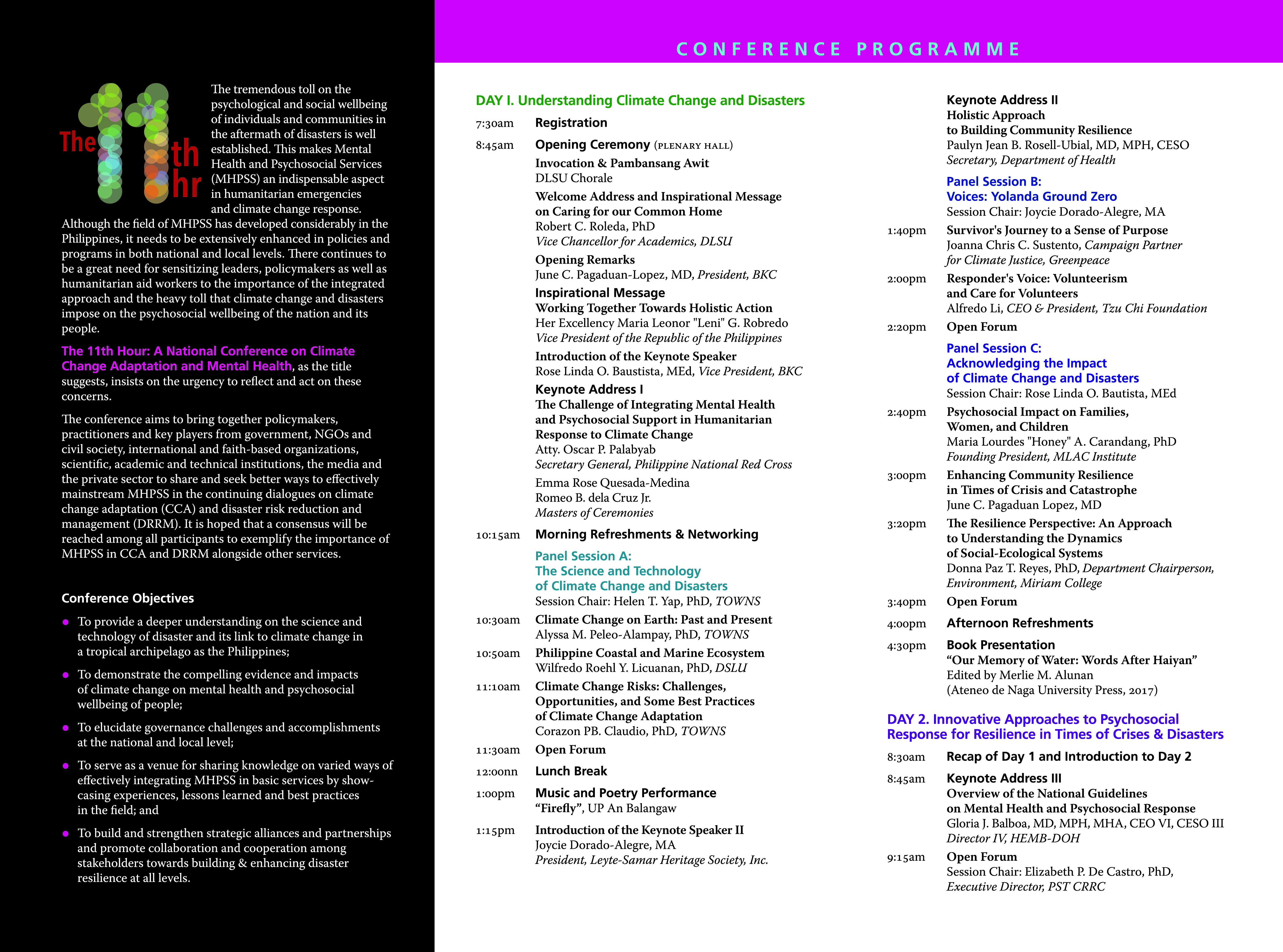
The same zest by the survivors enthuses mental health professional and advocates to engage in conversations and discourses on the nexus between climate change and mental health. Hence, in March 22-23, the Balik Kalipay Center in collaboration with DOH, DLSU, DLSU-CSB and other partner organizations, will hold a conference to serve as a platform for such conversations. This two-day conference brings together stakeholders from various government and civil society organizations into a forum to tackle how MHPSS can be mainstreamed in various arenas as a vehicle towards disaster risk reduction and management and climate change adaptation.
If you are interested to take part, either as an attendee or partner, for the conference, please email the11thhrsecretariat@gmail.com (Ms. Abigail Del Puerto, Conference Head) and visit our website http://www.balikkalipay.org/the-11th-hour.

 Nephtaly Joel Botor